
International Day Commemorating Victims of Violence Based on Religion or Belief 2026: Meaning, History & How to Observe
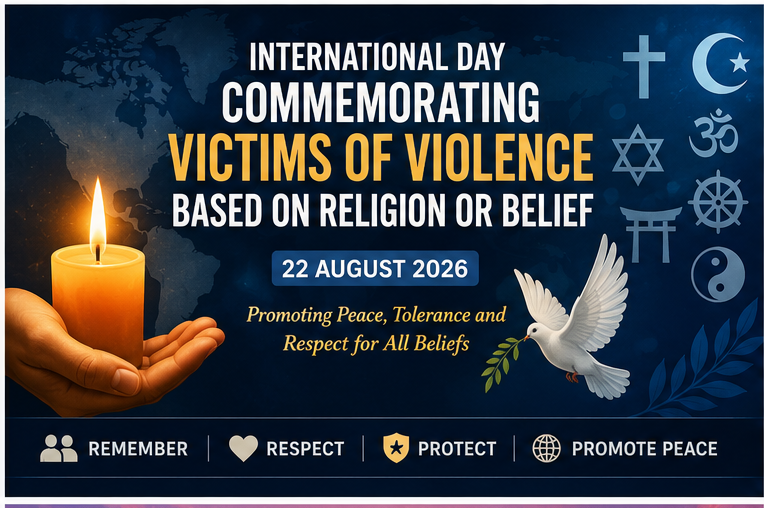
Direct Answer: The United Nations observes the International Day Commemorating the Victims of Acts of Violence Based on Religion or Belief every year on 22 August. The day remembers people who have been attacked, harassed or otherwise harmed because of their religion or belief and calls for protection of human rights, victim support, accountability, tolerance and peaceful coexistence. It is a remembrance and awareness day, not a celebration, so respectful language is more appropriate than “Happy” greetings.
22 August 2026 – What Is This UN International Day?
On 22 August 2026, people, institutions and communities around the world mark the International Day Commemorating the Victims of Acts of Violence Based on Religion or Belief. The United Nations General Assembly designated 22 August through resolution A/RES/73/296, adopted in 2019. The resolution recognises the importance of supporting victims and their families and condemns violence against people on the basis of religion or belief.
The observance also reinforces a broader principle: terrorism and violent extremism should not be associated with any religion, nationality, civilisation or ethnic group. That distinction matters because collective blame can deepen prejudice and create new cycles of hostility. A victim-centred approach focuses on dignity, safety, justice and prevention rather than using suffering to attack another community.
Why the Day Matters in 2026
Religious identity and belief can be deeply personal, but human rights protections apply to everyone—including people with a religion, people who change their religion, people belonging to minority faiths and people with no religious belief. Freedom of religion or belief is connected with freedom of opinion, expression, peaceful assembly and association.
In its 2026 message, the UN Secretary-General again highlighted violence targeting people because of faith, attacks on places of worship, hostility faced by religious minorities and the role of online hate. The message called on governments to address discrimination and bring perpetrators to justice, on religious leaders to reject violence, and on technology companies to reduce stigma and scapegoating on their platforms.
The significance of the day is therefore practical as well as symbolic. Remembering victims should lead to better support systems, safer public spaces, responsible leadership, human-rights education and faster action when threats appear.
What Does “Religion or Belief” Mean?
The phrase is intentionally broad. Human-rights protection is not limited to members of large or officially recognised religions. It includes the freedom to hold a belief, adopt or change a religion or belief, practise individually or with others, and also to have non-religious convictions, subject to the limits recognised under human-rights law.
This means the principle cannot be applied selectively. A society cannot credibly defend freedom of belief for one group while ignoring violence or discrimination against another. Equal dignity is the foundation of the observance.
History of the International Day
The UN General Assembly adopted resolution A/RES/73/296 on 28 May 2019 and designated 22 August as the annual international day. The resolution invites Member States, UN organisations, regional bodies, civil society, individuals and the private sector to observe the day appropriately.
The resolution specifically recognises the need to provide victims of violence based on religion or belief and their families with appropriate support and assistance in accordance with applicable law. It also points to interreligious, interfaith and intercultural efforts, human-rights education and legal protections against discrimination and hate crimes as important parts of prevention.
Victim-Centred Remembrance: What It Should Look Like
Respectful remembrance begins by centring people who suffered rather than sensationalising violence. Names, stories and experiences should be shared only with appropriate care, and graphic images should not be used merely to attract attention. When discussing a specific attack, facts should come from credible sources and language should avoid implying that an entire religious or ethnic community is responsible for the actions of individuals or organisations.
Victim support can include access to justice, physical and mental-health services, financial or social assistance, protection from further threats and recognition of the needs of surviving family members. Different victims need different forms of support; no single response fits every situation.
How Schools Can Observe 22 August
Schools can mark the day without turning the classroom into a debate over which religion is “right.” The educational goal should be human dignity, constitutional or human-rights principles, media literacy and respectful dialogue.
- Explain the purpose of the UN observance in age-appropriate language.
- Discuss why collective blame and stereotypes can cause harm.
- Teach students how to verify claims before forwarding inflammatory content.
- Create a short activity on the Universal Declaration of Human Rights.
- Ask students to write a reflection on dignity, tolerance and peaceful disagreement.
- Use examples that represent multiple communities rather than singling out one group.
- Set clear classroom rules against mockery of religious or non-religious identity.
How Colleges and Workplaces Can Observe
Colleges can organise a moderated panel on freedom of religion or belief, digital hate, victim support or interfaith cooperation. Panels should include credible expertise and clear moderation so the event does not become a platform for hostility. Student clubs can create reading lists, human-rights explainers or campaigns about responsible online behaviour.
Workplaces can use the day to review anti-harassment policies, reasonable accommodation practices, reporting channels and inclusion training. The focus should remain on equal treatment and professional respect. Employees should not be pressured to disclose or perform religious identity as part of an awareness activity.
Responsible Social Media on This Day
Social platforms can amplify both solidarity and misinformation. Before sharing a claim about an incident, check the source, date, location and whether images are being reused from another event. Avoid forwarding screenshots without context. Do not post private information about victims, witnesses or alleged perpetrators unless it has been responsibly published by credible sources and is necessary to the public-interest discussion.
Language also matters. Replace sweeping statements about communities with precise descriptions of verified actors and events. Avoid hashtags that encourage retaliation or dehumanisation. If a post is clearly designed to provoke hatred, reporting it may be more constructive than quote-posting it to a larger audience.
How Religious and Community Leaders Can Help
Leaders can reduce tension by condemning violence consistently, regardless of the victim’s identity. They can correct rumours, discourage retaliation, cooperate with other communities and create channels for early dialogue. Joint statements are most useful when they are specific about protecting people and rejecting violence without erasing legitimate differences in belief.
Community leaders can also help victims navigate support systems, accompany families seeking assistance and work with local institutions to improve safety around places of worship. Prevention is stronger when relationships are built before a crisis occurs.
The Role of Governments and Institutions
Public institutions have a responsibility to protect people equally under the law. Effective responses can include fair investigation of crimes, protection of threatened communities, prosecution based on evidence and law, anti-discrimination measures, support for victims and training for officials who respond to hate incidents.
Human-rights protection should not become an excuse to suppress peaceful belief, peaceful criticism or legitimate expression. The challenge is to distinguish protected expression from unlawful threats, incitement or violence according to applicable law and human-rights standards.
Digital Platforms, Hate Speech and Safety
Online hostility can move quickly from insults to targeted harassment, doxxing, threats and real-world risk. Platforms can reduce harm through clear rules, consistent enforcement, user-reporting tools, friction against mass harassment and better attention to languages and regions that may receive less moderation coverage.
Users also have a role. Do not reward hateful content with engagement merely because it makes you angry. Save evidence when a threat may need reporting, use platform safety tools and contact appropriate local authorities when there is a credible risk of violence. For immediate danger, prioritise real-world emergency support rather than online argument.
What You Can Do Personally on 22 August
- Read the UN page explaining the observance and its human-rights basis.
- Learn about a community or belief tradition without reducing it to stereotypes.
- Check facts before forwarding emotionally charged claims.
- Speak up when friends or colleagues use dehumanising language.
- Support credible organisations that assist victims of violence or discrimination.
- Respect places of worship and community spaces.
- Make room for peaceful disagreement without humiliation or threats.
- Teach children that difference does not justify cruelty.
Words to Use—and Words to Avoid
Appropriate language includes “remember the victims,” “stand against violence,” “support freedom of religion or belief,” “protect human dignity,” and “reject hatred and collective blame.” Avoid celebratory language such as “Happy International Day,” because this date commemorates victims. Also avoid slogans that imply one community is uniquely violent or uniquely innocent; the observance is based on universal rights.
World Humanitarian Day 2026 – Humanity Messages
Sadbhavana Diwas 2026 – Peace & Unity Messages
Partition Horrors Remembrance Day 2026 – History & Meaning
FAQ – International Day Commemorating Victims of Violence Based on Religion or Belief
1. This international day is observed on which date?
It is observed every year on 22 August.
2. Who established the observance?
The United Nations General Assembly designated the day through resolution A/RES/73/296 in 2019.
3. What is the main purpose of the day?
It remembers victims of violence based on religion or belief and promotes victim support, human rights, accountability, tolerance and prevention.
4. Is this a religious festival?
No. It is a UN human-rights remembrance and awareness observance.
5. Should we say “Happy” on this day?
It is better not to. Respectful remembrance language is more appropriate because the day commemorates victims.
6. Does freedom of religion or belief protect only religious people?
No. Human-rights principles also protect the freedom to change belief and to hold non-religious beliefs.
7. How can schools observe it?
Schools can use age-appropriate lessons on human rights, tolerance, stereotypes, misinformation and peaceful dialogue.
8. How can social-media users help?
Verify claims, avoid collective blame, do not amplify hateful content unnecessarily and report credible threats through appropriate channels.
9. What can workplaces do?
Review anti-harassment policies, reporting systems, equal-treatment practices and respectful accommodation of belief.
10. What is the most important message of 22 August?
No person should face violence, fear or discrimination because of religion or belief, and protecting one group’s dignity strengthens safety for everyone.
Conclusion
The International Day Commemorating the Victims of Acts of Violence Based on Religion or Belief asks us to do more than post a slogan. It asks societies to remember victims with dignity, support survivors, uphold equal rights and prevent hatred from becoming violence. On 22 August 2026, the most constructive response is simple: reject collective blame, verify information, defend peaceful freedom of belief for everyone and support systems that keep people safe.