
International Day for the Remembrance of the Slave Trade and its Abolition 2026: History, Meaning & How to Observe
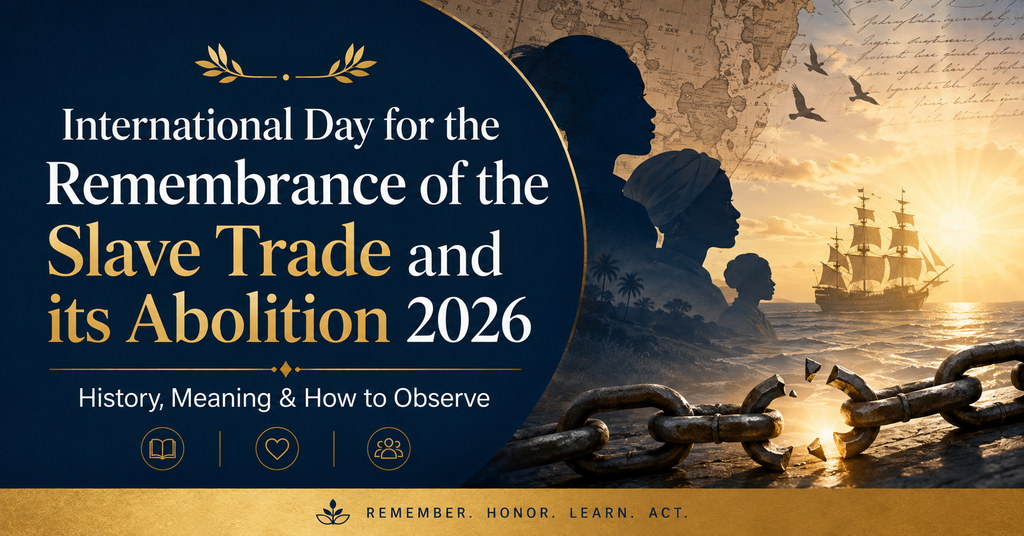
Direct Answer: International Day for the Remembrance of the Slave Trade and its Abolition is observed every year on 23 August. UNESCO established the observance to remember people affected by the slave trade, reflect on the history and consequences of slavery, and encourage learning about freedom, dignity, resistance and human rights. The date is linked to the uprising that began during the night of 22–23 August 1791 in Saint-Domingue, now Haiti, an event that became important in the wider struggle against slavery.
What is the International Day for the Remembrance of the Slave Trade and its Abolition?
This international observance is a day of remembrance and education rather than a festive celebration. Its purpose is to keep the history of the slave trade in public memory and to create space for serious discussion about how slavery affected societies across Africa, Europe, the Americas and the Caribbean. It also encourages people to learn about the resistance of enslaved communities and the long struggles that contributed to abolition.
The topic can be difficult because it involves violence, exploitation, displacement and the denial of basic human dignity. For that reason, schools, media pages and social accounts should approach the day with accurate history and respectful language. The goal is not to sensationalize suffering; it is to understand the people, systems, resistance movements and legacies connected with this history.
Why is 23 August important?
UNESCO connects 23 August with the uprising that began in the French colony of Saint-Domingue during the night of 22 to 23 August 1791. The revolt became a major turning point in the history of resistance to slavery and was part of the wider process that eventually led to Haitian independence. UNESCO chose the date as a symbolic moment for remembering enslaved people and examining the global history of the slave trade and abolition.
The day has been observed internationally for decades, with early commemorations held in places including Haiti and Gorée Island in Senegal. Today, educators, cultural institutions, museums, researchers, artists and communities can use the date to discuss historical evidence, memory and the continuing importance of human dignity and equality.
What should we learn from the history of the slave trade?
The slave trade was not only the movement of people from one place to another. It involved organized systems that treated human beings as property, separated families, disrupted communities and created long-lasting economic, political and cultural consequences. Studying this history helps explain parts of the modern world that cannot be understood only through dates and political events.
At the same time, historical study should not portray enslaved people only as passive victims. People resisted in many ways: through rebellion, escape, preservation of culture, community building, legal action, political organization, storytelling and everyday efforts to protect identity and family. Learning about resistance makes the history more complete and gives agency to people whose experiences were often excluded from older narratives.
How to observe 23 August respectfully
1. Read from credible historical sources
Start with museums, archives, universities, UNESCO resources and well-researched books. When sharing facts online, verify dates and context before posting. This is especially important because oversimplified social-media posts can turn a complex history into inaccurate slogans.
2. Learn one personal or community story
Large statistics are important, but individual stories help people understand the human impact of historical systems. A classroom or family can learn about one community, one resistance movement, one abolitionist effort or one historical site and then discuss what that story reveals about the wider period.
3. Visit a museum, archive or digital exhibition
If a local museum or heritage institution has relevant material, explore it. When an in-person visit is not possible, many institutions provide digital collections and educational resources. Historical documents, maps and oral traditions can help learners distinguish evidence from myth.
4. Hold a classroom discussion
Teachers can frame the day around questions such as: How do societies remember difficult history? Why does language matter when describing enslaved people? What forms can resistance take? How should monuments, archives and museums preserve painful histories? These questions encourage critical thinking without turning the topic into a competition over suffering.
5. Reflect on dignity and human rights
The observance can also be used to discuss the principle that every person has equal human dignity. When making connections to present-day exploitation or trafficking, be precise and avoid suggesting that different historical systems are identical. Responsible comparison should clarify similarities and differences rather than erase them.
Ideas for schools and colleges
- Timeline activity: Build a carefully sourced timeline of major events related to slavery, resistance and abolition in a specific region.
- Map project: Study how forced movement connected regions across the Atlantic and how communities were affected.
- Biography project: Research a resistance leader, abolitionist, writer, survivor or community whose story adds a human perspective.
- Primary-source reading: Examine a short historical document with teacher guidance and discuss who created it, why and what its limits are.
- Memory and heritage discussion: Explore how museums, memorials and cultural traditions help societies remember difficult pasts.
- Creative reflection: Students can write a short essay, poem or reflection focused on dignity, freedom and responsible remembrance without fictionalizing real suffering.
Social media caption ideas for a remembrance post
A respectful social post should prioritize remembrance and learning rather than celebratory language. Avoid “Happy” greetings for this observance. Short captions can focus on memory, dignity, education and the importance of understanding history.
23 August is a day to remember, learn and reflect on the history of the slave trade and the people who resisted it.
Remembering the past responsibly helps us value freedom, dignity and equality in the present.
Today we honour memory through learning—by listening to history, preserving evidence and respecting human dignity.
Remembrance is more meaningful when it leads to deeper understanding, careful education and respect for every person.
On 23 August, let us make space for history, memory, resistance and the universal value of human dignity.
Why language matters when writing about this day
Words influence how readers understand history. Prefer language that recognizes people as human beings first rather than reducing them to their condition. Many historians and institutions use terms such as “enslaved people” to emphasize that enslavement was imposed on individuals rather than being their identity. Context also matters: terms used in historical documents may reflect the prejudices and power structures of their time.
Writers should also separate documented history from opinion. If a detail is disputed or varies across scholarship, say so instead of presenting one interpretation as unquestionable fact. This approach improves both educational quality and trust.
How remembrance connects with culture and heritage
The history of the slave trade influenced languages, music, religion, food traditions, literature, family histories and cultural practices across many regions. Cultural survival can itself be part of the story of resistance. Studying heritage therefore offers another way to understand how communities responded to displacement and oppression while creating new forms of identity and expression.
UNESCO’s work on the topic also highlights the importance of archives, historical sites and cultural heritage. Preserving records helps future generations study what happened using evidence rather than relying only on simplified retellings.
For another human-rights-related observance, read IG Store News & Awareness articles. You can also explore the previous day’s article on the International Day Commemorating Victims of Violence Based on Religion or Belief 2026.
Frequently Asked Questions
1. When is the International Day for the Remembrance of the Slave Trade and its Abolition?
It is observed every year on 23 August.
2. Who established this international observance?
UNESCO established and promotes the observance as a day for remembrance, education and reflection.
3. Why was 23 August selected?
The date recalls the uprising that began in Saint-Domingue during the night of 22–23 August 1791 and became significant in the history of resistance to slavery.
4. Is this a celebration day?
No. It is more appropriately treated as a remembrance and educational observance. Respectful language is preferable to celebratory greetings.
5. What can schools do on this day?
Schools can organize researched timelines, discussions, museum-resource activities, biography projects and lessons using carefully selected primary and secondary sources.
6. What should a social media post say?
Focus on remembrance, historical learning, dignity, resistance and equality. Avoid sensational images or unsupported claims.
7. Why is studying resistance important?
It shows that enslaved people were historical actors who challenged oppression in many ways and helps avoid presenting them only as passive victims.
8. Can this day be connected to modern human-rights topics?
Yes, but comparisons should be careful and historically precise. Different systems of exploitation have distinct contexts even when they raise related questions about dignity and freedom.
9. Where should students look for reliable information?
UNESCO, museums, archives, universities and reputable academic publications are strong starting points.
10. What is the main message of the day?
Remember the people affected by the slave trade, understand the history and its legacies, recognize resistance, and protect the principle of equal human dignity.
Conclusion
International Day for the Remembrance of the Slave Trade and its Abolition is an opportunity to study a difficult but essential part of global history with care. Meaningful observance comes from accurate learning, respectful remembrance and attention to the voices and resistance of people whose freedom was denied. On 23 August, the most useful action is not a simple greeting but a commitment to remember responsibly and learn more deeply.
Reference: UNESCO’s official International Day resource.
-
Posted in
2026, 23 August, Abolition, History, Human Rights, Slave Trade Remembrance, UNESCO