
Solar Eclipse August 12, 2026 in USA: Times, States, Visibility & Eye Safety Guide
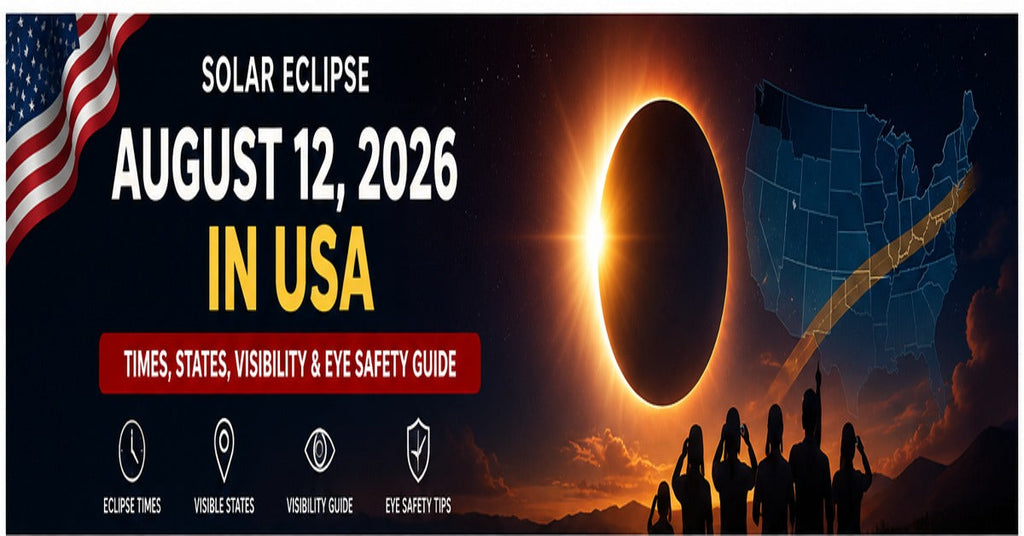
Quick answer: The solar eclipse on August 12, 2026 will be a partial solar eclipse in the United States. The path of totality does not cross the U.S. NASA says parts of the northern U.S.—from Alaska toward North Carolina—can see a partial eclipse, with the amount of Sun covered varying widely by location. Alaska gets some of the strongest U.S. views.
For U.S. readers searching “solar eclipse August 12 2026 time near me,” the most important point is that eclipse timing is local. A city can differ substantially from another city even in the same region, so use the examples below as reference points and verify your exact location with NASA’s eclipse map.
Will the August 12, 2026 Eclipse Be Total in the USA?
No. Totality crosses Greenland, Iceland, northern Russia, the North Atlantic, Spain and a small corner of Portugal. In the United States, observers remain outside the path of totality and see only a partial eclipse where the eclipse is visible.
That safety distinction matters: because the Sun is never completely covered for U.S. observers, proper solar eye protection is required for the entire time you look directly at the eclipse.
August 12, 2026 Solar Eclipse Times in the USA
NASA lists the following sample city times. All times are local to each city.
| City | Partial Begins | Maximum | Coverage | Partial Ends |
|---|---|---|---|---|
| Anchorage, Alaska | 7:36 AM | 8:21 AM | 28% | 9:09 AM |
| Bangor, Maine | 12:54 PM | 1:53 PM | 24% | 2:49 PM |
| Boston, Massachusetts | 1:01 PM | 1:55 PM | 16% | 2:46 PM |
| Detroit, Michigan | 1:03 PM | 1:36 PM | 3% | 2:08 PM |
NASA also lists Fairbanks, Alaska at about 37% coverage and New York City at about 9%, showing how quickly eclipse magnitude changes across the country.
Which U.S. States Can See the Eclipse?
NASA describes partial-eclipse visibility across parts of the northern United States, broadly from Alaska to North Carolina. Visibility and coverage are not uniform across an entire state. In some places the “bite” taken from the Sun will be noticeable; farther from the eclipse path it can be small.
For the most accurate answer, check your exact city or coordinates on the official NASA August 12, 2026 eclipse page.
Best U.S. Viewing Areas
Among NASA’s listed U.S. examples, Alaska offers stronger partial coverage than most of the contiguous U.S. Fairbanks is listed near 37% and Anchorage near 28%. Bangor, Maine is around 24%, while Boston is around 16% and Detroit around 3%.
Weather is just as important as eclipse geometry. A location with higher theoretical coverage can still have a poor view if clouds block the Sun, so check the local forecast on the morning of August 12.
Solar Eclipse Eye Safety: What You Must Know
NASA states that during a partial solar eclipse it is never safe to look directly at the Sun without proper eye protection.
- Use safe solar viewing glasses (“eclipse glasses”) or a safe handheld solar viewer.
- Regular sunglasses are not safe, no matter how dark they appear.
- Safe solar viewers should comply with the ISO 12312-2 international standard.
- Do not look through a camera, binoculars or telescope while wearing eclipse glasses. Concentrated sunlight can damage the filter and your eyes.
- Optical devices need a special-purpose solar filter attached to the front of the optics.
- If you do not have safe solar viewers, use an indirect method such as a pinhole projector.
Because U.S. viewers do not experience totality on August 12, there is no U.S. “glasses-off” totality phase.
Can I Photograph the Eclipse?
Yes, but a phone or camera does not make direct solar viewing safe. If you use a camera with optical zoom, a telescope or binoculars, follow manufacturer guidance and use a proper front-mounted solar filter designed for that equipment. Never improvise with sunglasses, smoked glass or household materials.
What Time Will the Eclipse Happen Near Me?
In Alaska, the partial eclipse occurs in the morning. In parts of the northern contiguous U.S., it begins around midday and can continue into mid-afternoon farther east. Exact contact times depend on your location.
If you are outside the visible path or clouds interfere, NASA says it will stream the eclipse live starting at 1:15 PM EDT on August 12.
Why Is This Eclipse Getting So Much Attention?
It is a total solar eclipse globally, with a path of totality crossing Iceland and parts of Spain—areas that are relatively accessible compared with many remote eclipse paths. For U.S. audiences it is a partial-eclipse event, but it still creates strong search interest because it is the next major total solar eclipse visible across parts of the Northern Hemisphere.
What About India?
The search intent is different for India because visibility and traditional Sutak questions matter there. We have kept that information in a separate guide so this USA article stays focused: Surya Grahan 12 August 2026: India Visibility, Sutak Rules, Timing & Safety.
Quick Checklist for August 12
- Confirm that the eclipse is visible from your exact location.
- Check local start, maximum and end times.
- Get proper eclipse glasses or a safe handheld solar viewer before the event.
- Inspect viewers for damage before use.
- Check the local weather forecast.
- Choose an open location with a clear view of the Sun.
- Supervise children carefully during direct solar viewing.
FAQs: August 12, 2026 Solar Eclipse USA
Is there a total solar eclipse in the USA on August 12, 2026?
No. The U.S. sees only a partial eclipse in the areas where it is visible.
Where is the August 12 eclipse total?
Totality crosses Greenland, Iceland, northern Russia, the Atlantic, Spain and a small corner of Portugal.
What time is the eclipse in Anchorage?
NASA lists the partial eclipse beginning at 7:36 AM, maximum at 8:21 AM and ending at 9:09 AM local time, with about 28% coverage.
What time is the eclipse in Boston?
NASA lists 1:01 PM start, 1:55 PM maximum and 2:46 PM end, with about 16% coverage.
Can I use normal sunglasses?
No. Regular sunglasses are not safe for direct solar viewing.
Do I need eclipse glasses for the whole event in the USA?
Yes, whenever you look directly at the Sun. U.S. locations do not enter totality on August 12.
Can I watch without eclipse glasses?
You can use a safe indirect viewing method such as a pinhole projector, where you look at the projected image rather than directly at the Sun.
Source note: U.S. visibility, sample city times and safety guidance in this article are based on NASA’s official August 12, 2026 eclipse information. Always verify your exact location before viewing.